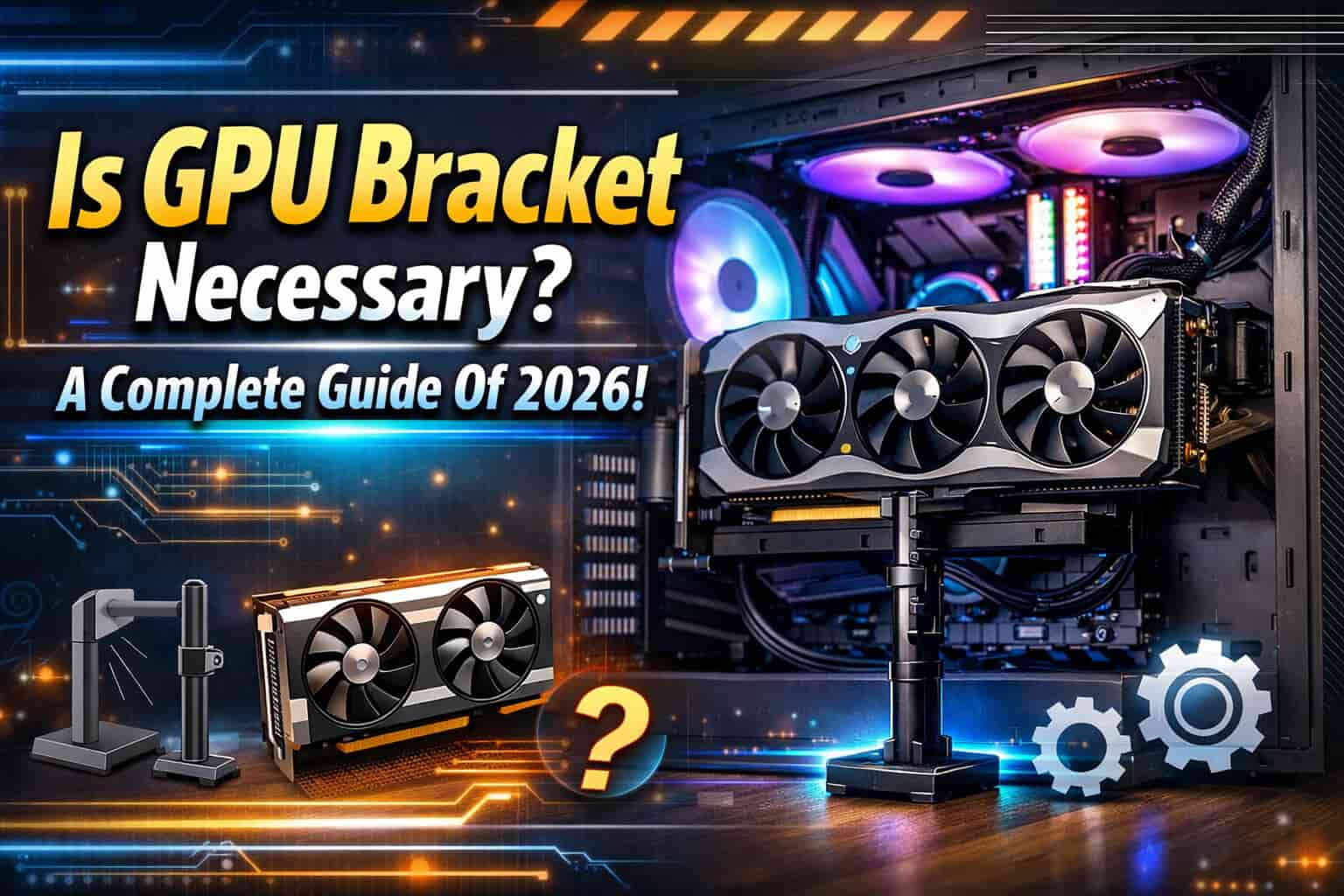
A graphics card (GPU) is one of the heaviest parts inside a computer. Many modern GPUs are large, long, and heavy. Because of this weight, users often see the GPU bending or sagging inside the PC case. This raises an important question: Is a GPU bracket necessary?
A GPU bracket is not always necessary, but it is highly recommended for modern, heavy graphics cards. Large GPUs can sag over time, putting stress on the PCIe slot and motherboard. A support bracket helps keep the card level and prevents long-term damage. Smaller or lightweight GPUs usually do not need one, but using a bracket is a safe precaution.
In this detailed guide, you will learn what a GPU bracket is, why GPU sag happens, whether you really need a GPU support bracket, and how it protects your graphics card. This article covers every related topic to build full topical authority.
What Is a GPU Bracket?
A GPU bracket is a support tool used inside a computer case to hold the graphics card in a straight position. It helps reduce pressure on the motherboard and PCIe slot.
GPU brackets are also called:
- GPU support bracket
- GPU anti-sag bracket
- Graphics card support
They usually sit under the GPU and support its weight from the bottom.
What Is GPU Sag?
GPU sag happens when a graphics card bends downward due to its heavy weight. This is common with modern GPUs like RTX 3070, RTX 3080, RTX 4090, and similar AMD cards.
GPU sag looks like:
- The GPU tilts down on one side
- The card is not straight
- The PCIe slot looks stressed
Over time, this sag can cause serious hardware problems.
Why Do Modern GPUs Sag?
Modern GPUs sag for several reasons:
1. Heavy GPU Coolers
New graphics cards use large heatsinks and multiple fans. These coolers add extra weight.
2. Long GPU Size
Many GPUs are very long. The longer the card, the more pressure it puts on the PCIe slot.
3. Weak Case Support
Some PC cases do not provide strong horizontal support for GPUs.
4. Thin PCB Design
Some graphics cards have thin circuit boards that bend easily under weight.
Is GPU Bracket Necessary?
Yes, a GPU bracket is necessary in many cases, especially if you use a heavy or long graphics card.
A GPU bracket is recommended if:
- Your GPU is sagging
- Your GPU has 2.5 or 3 slots
- You use a high-end GPU
- You move your PC often
- You want long-term hardware safety
For small or light GPUs, a bracket may not be required.
What Happens If You Do Not Use a GPU Bracket?
Not using a GPU bracket can cause multiple problems over time.
1. PCIe Slot Damage
The weight of the GPU can slowly damage the PCIe slot on the motherboard.
2. GPU PCB Cracks
Continuous bending can cause cracks in the GPU circuit board.
3. Poor Electrical Contact
Sagging can reduce proper contact between the GPU and the PCIe slot.
4. Display Issues
You may face screen flickering, no display, or random crashes.
5. Reduced GPU Lifespan
Hardware stress can shorten the life of your graphics card.
Does GPU Sag Affect Performance?
GPU sag does not reduce performance directly, but it can cause problems that affect performance indirectly.
Possible issues include:
- Random crashes during gaming
- GPU not detected properly
- Black screen errors
- System instability
Preventing sag helps keep the system stable.
Are GPU Brackets Safe to Use?
Yes, GPU brackets are completely safe when installed correctly.
They do not:
- Damage the GPU
- Reduce airflow
- Cause electrical issues
Most brackets are adjustable and designed to fit many cases and GPUs.
Types of GPU Brackets
There are different types of GPU brackets available.
1. Vertical Support GPU Bracket
This type supports the GPU from the bottom using a metal or plastic rod.
Best for:
- Large and heavy GPUs
- Most PC cases
2. Horizontal GPU Brace
This bracket mounts along the GPU length and connects to case slots.
Best for:
- Wide cases
- Clean builds
3. GPU Bracket With RGB
This type includes RGB lighting and works as both support and decoration.
Best for:
- Gaming PC builds
- RGB-focused setups
4. Built-in Case GPU Support
Some modern PC cases include a built-in GPU support bracket.
Best for:
- New PC cases
- Easy installation
Do All GPUs Need a Support Bracket?
No, not all GPUs need a bracket.
GPUs That Usually Do Not Need a Bracket
- Low-profile GPUs
- Single-fan GPUs
- Entry-level graphics cards
- Short-length GPUs
GPUs That Need a Bracket
- RTX 3080, RTX 3090, RTX 4090
- RX 6800, RX 6900, RX 7900
- Triple-fan GPUs
- GPUs longer than 280mm
Is GPU Sag a Manufacturing Defect?
No, GPU sag is not a defect. It happens due to:
- Gravity
- Heavy coolers
- Case design
Manufacturers expect users to manage GPU weight with proper support.
Does a GPU Bracket Improve Airflow?
A GPU bracket does not block airflow when installed properly.
In some cases, it can help:
- Keep GPU fans aligned
- Prevent uneven fan spacing
Always choose a slim bracket for better airflow.
Can GPU Sag Damage the Motherboard?
Yes, GPU sag can damage the motherboard over time.
Possible motherboard issues:
- Broken PCIe slot
- Cracked solder joints
- Signal instability
Using a GPU bracket reduces this risk.
Is GPU Bracket Necessary for Gaming PCs?
For gaming PCs with high-end GPUs, a GPU bracket is strongly recommended.
Gaming causes:
- Heat expansion
- Fan vibration
- Long usage hours
All these increase stress on the GPU slot.
Is GPU Bracket Necessary for Workstations?
Yes, especially for:
- Video editing PCs
- 3D rendering systems
- AI and CUDA workloads
Workstations run GPUs for long hours, making support very important.
GPU Bracket vs Vertical GPU Mount
GPU Bracket
- Simple
- Cheap
- Easy to install
- Keeps GPU horizontal
Vertical GPU Mount
- Expensive
- Needs riser cable
- Can affect airflow
A GPU bracket is a safer and easier option for most users.
How to Install a GPU Bracket
Installing a GPU bracket is simple.
Basic Steps:
- Turn off the PC
- Open the side panel
- Adjust the bracket height
- Place it under the GPU
- Secure it properly
Make sure the GPU is straight and not forced upward.
Common Mistakes When Using a GPU Bracket
Avoid these mistakes:
- Applying too much pressure
- Blocking GPU fans
- Using the wrong size bracket
- Poor alignment
Always adjust gently.
Do GPU Manufacturers Recommend GPU Brackets?
Yes, many GPU manufacturers recommend support brackets for large GPUs.
Some GPUs even include:
- Built-in metal frames
- Reinforced PCBs
- Support accessories
This shows how common GPU sag is.
Can You Make a DIY GPU Bracket?
Yes, some users use:
- Plastic rods
- LEGO pieces
- Metal stands
However, a proper GPU bracket is safer and more reliable.
How Much Does a GPU Bracket Cost?
GPU brackets are affordable.
Average price range:
- Basic bracket: Low cost
- RGB bracket: Medium cost
Compared to GPU price, a bracket is very cheap protection.
Is GPU Bracket Worth It?
Yes, a GPU bracket is worth it if you want:
- Hardware safety
- Long GPU life
- Better system stability
- Peace of mind
It is a small investment with big benefits.
Signs You Need a GPU Bracket
You should install a GPU bracket if:
- Your GPU looks tilted
- The end of GPU is lower
- The motherboard slot looks stressed
- You hear fan vibration noise
These are early warning signs.
What is a GPU Support Bracket?
A GPU support bracket is an accessory designed to hold up a graphics card and prevent it from sagging due to its weight. Modern GPUs are large and heavy, which can stress the PCIe slot over time. A support bracket helps maintain proper alignment, protects the motherboard slot, and improves long-term hardware durability.
When should I use a holding bracket for GPU?
You should use a GPU holding bracket when your graphics card is large, heavy, or visibly sagging after installation. Triple-fan GPUs and cards with metal coolers benefit the most. If your PC is frequently moved or shipped, a bracket is strongly recommended to reduce stress on the PCIe slot and motherboard.
Do I need a graphics card support bracket?
A graphics card support bracket is not mandatory for all systems, but it is highly recommended for heavy GPUs. If your GPU causes noticeable sag or puts pressure on the PCIe slot, a bracket can prevent long-term damage. Smaller or lightweight GPUs usually do not need one.
Can you install a GPU without a bracket?
Yes, you can install a GPU without a bracket, and many systems run fine this way. However, heavy GPUs may sag over time without support. While it may work initially, long-term use without a bracket can stress the PCIe slot and potentially damage the motherboard.
Is a GPU backplate needed?
A GPU backplate is not required for performance, but it provides structural support and helps prevent PCB bending. It can also improve heat dissipation and protect components on the back of the card. While a backplate reduces sag slightly, it does not fully replace a GPU support bracket.
How do you know if you need a GPU sag bracket?
If your GPU appears tilted downward or uneven when installed, you likely need a sag bracket. Other signs include visible bending, uneven pressure on the PCIe slot, or concern due to the GPU’s size and weight. Checking the card from the side panel view helps identify sag easily.
Do I need a GPU support bracket for 4070?
Many RTX 4070 models are mid-sized and lighter than higher-end cards, so a support bracket is not always necessary. However, larger triple-fan or factory-overclocked versions may still sag. If your specific 4070 model is long or heavy, using a bracket is a safe and inexpensive precaution.
Do I need a GPU support bracket for 5070 Ti?
If the RTX 5070 Ti follows the trend of modern high-performance GPUs, it is likely to be large and heavy. In that case, a GPU support bracket would be recommended, especially for long-term use. A bracket helps prevent sag, protects the PCIe slot, and improves system reliability.
Do I need a GPU support bracket for 9070XT?
High-end GPUs like a 9070XT-class card are typically large, heavy, and power-dense. A GPU support bracket is strongly recommended to prevent sag and motherboard stress. Using a bracket ensures better weight distribution and protects both the GPU and PCIe slot during long-term operation.
Best GPU support bracket?
The best GPU support bracket depends on your case and GPU size. Adjustable vertical brackets, magnetic base brackets, and case-mounted brackets are popular choices. Look for a sturdy metal design with easy height adjustment. Compatibility with your case layout and GPU length is more important than brand alone.
How to use GPU support bracket?
To use a GPU support bracket, install the GPU first, then place the bracket under the card’s far end. Adjust the height so it gently supports the GPU without lifting it excessively. Secure the bracket according to its design. Ensure the GPU remains level and does not flex upward.
Are anti-sag brackets necessary for graphics cards?
Anti-sag brackets are not strictly necessary, but they are highly recommended for modern, heavy graphics cards. They prevent long-term damage to the PCIe slot and GPU PCB. Considering their low cost and ease of installation, anti-sag brackets are a practical upgrade for most mid-range and high-end GPUs.
Final Verdict: Is GPU Bracket Necessary?
Yes, a GPU bracket is necessary for most modern graphics cards.
While small GPUs may not need it, high-end and heavy GPUs should always be supported. A GPU bracket protects your graphics card, motherboard, and system stability. It is simple, affordable, and effective.
If you want your GPU to last longer and stay safe, using a GPU bracket is a smart choice.
FAQs – Is GPU Bracket Necessary?
1. Is GPU sag dangerous?
Yes, GPU sag can damage the PCIe slot and GPU PCB over time if not supported properly.
2. Does GPU sag cause FPS drops?
No, sag does not reduce FPS directly, but it can cause crashes and system instability.
3. Can GPU sag break the graphics card?
Yes, long-term sag can cause cracks and electrical issues inside the GPU.
4. Is GPU bracket required for RTX 4090?
Yes, RTX 4090 is very heavy and a GPU bracket is strongly recommended.
5. Can I use GPU without bracket?
Yes, but it is risky for heavy GPUs and not recommended for long-term use.

Jerry Smith brings a decade of hands-on experience at Tesla, specializing in electric vehicle engineering, battery systems, and market analysis. As both an automotive practitioner and passionate investor, he blends technical insight with stock-market savvy to demystify Tesla’s innovations and financial narrative.
Related Posts