Do GPU fans always spin? – A Complete Guide Of 2026!
Many computer users notice that their GPU fans sometimes spin and sometimes stay still. This often causes confusion. Some people think the GPU is broken when the fans stop. Others worry about overheating or hardware damage.
So, do GPU fans always spin?
The simple answer is no.
In this detailed guide, we will explain everything you need to know about GPU fans. You will learn how GPU fans work, when they spin, when they stop, and why this behavior is normal. We will also cover fan control modes, temperature limits, common problems, and safety tips.
This article is written in simple English and is useful for beginners, gamers, and PC users.
What Is a GPU and Why Does It Need Fans?
A GPU (Graphics Processing Unit) is a hardware part that handles graphics tasks. It is used for:
- Gaming
- Video editing
- 3D design
- AI tasks
- Display output
When a GPU works, it creates heat. Too much heat can damage the GPU. To control heat, GPUs use cooling systems.
Common GPU Cooling Methods
- Fans
- Heat sinks
- Heat pipes
- Liquid cooling (in high-end systems)
Fans are the most common cooling method.
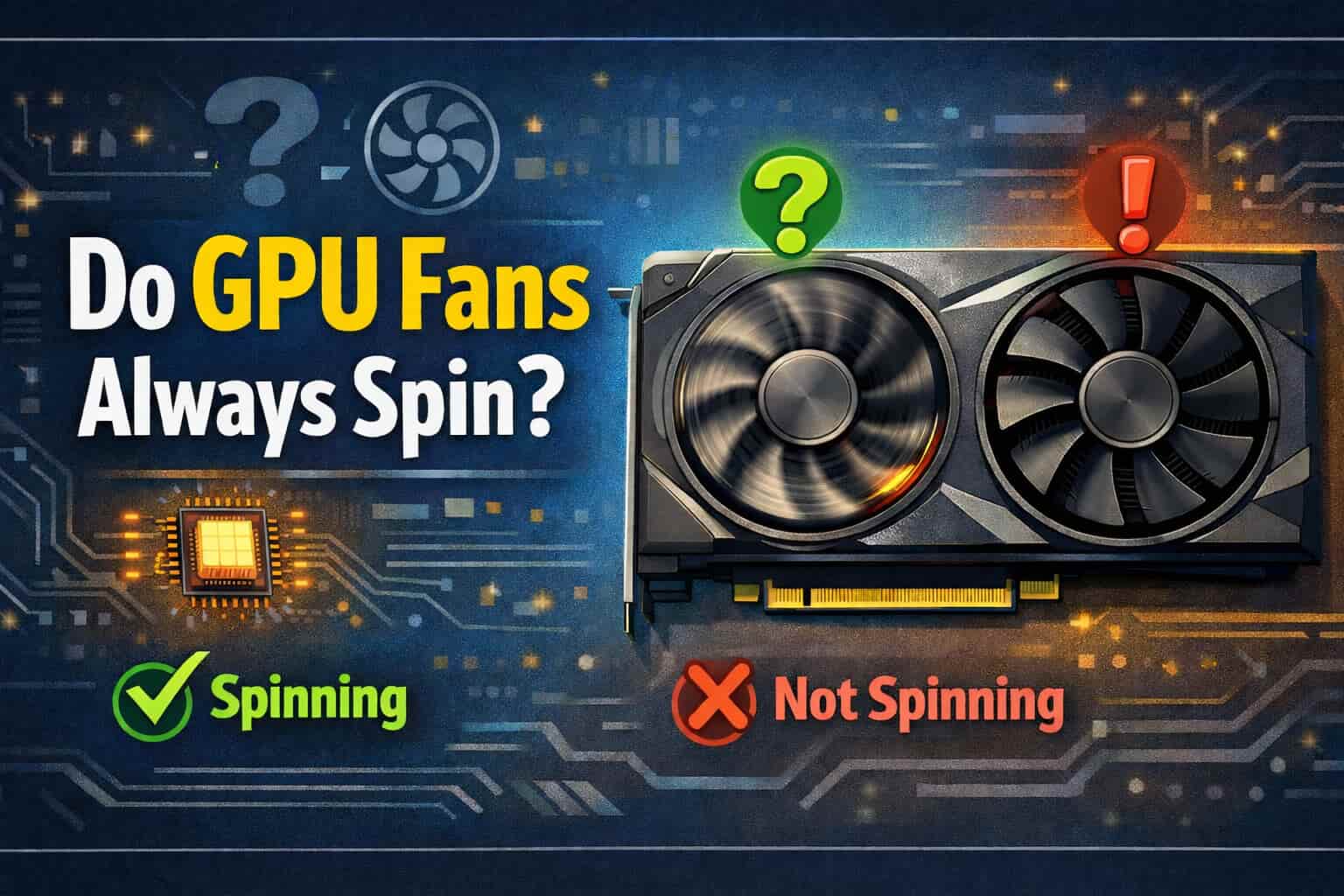
Do GPU Fans Always Spin?
No, GPU fans do not always spin.
Most modern GPUs use smart fan control. This means fans only spin when needed.
Key Point
If your GPU fans stop spinning at idle or low use, this is normal behavior.
Why Do GPU Fans Stop Spinning?
There are several reasons why GPU fans stop spinning.
1. Zero RPM Fan Mode
Many modern GPUs have Zero RPM Mode (also called Fan Stop Mode).
In this mode:
- Fans stop when the GPU is cool
- Fans start again when temperature increases
This feature:
- Reduces noise
- Saves fan life
- Uses passive cooling at low load
Typical Temperature Range
- Fans OFF: below 50–60°C
- Fans ON: above 55–65°C
These values depend on the GPU brand.
2. Low GPU Usage
When the GPU is idle or doing simple tasks like:
- Browsing the internet
- Watching videos
- Office work
It does not produce much heat. The heat sink alone can manage cooling, so fans stay off.
3. Manufacturer Fan Profile
Each GPU brand sets its own fan behavior.
Examples:
- NVIDIA Founders Edition
- ASUS, MSI, Gigabyte, Zotac custom cards
Some brands are more aggressive, others prefer silent operation.
When Do GPU Fans Start Spinning?
GPU fans start spinning when the GPU temperature reaches a certain level.
Common Scenarios
- Playing games
- Running heavy software
- Video rendering
- Stress testing
- AI or machine learning tasks
As load increases, temperature rises, and fans turn on automatically.
How GPU Fan Control Works
GPU fan speed is controlled by firmware and drivers.
Fan Speed Depends On
- GPU temperature
- Power usage
- Load percentage
- Fan curve settings
What Is a Fan Curve?
A fan curve is a rule that tells fans how fast to spin at different temperatures.
Example Fan Curve
- 30°C → 0% fan speed
- 50°C → 30% fan speed
- 70°C → 70% fan speed
- 85°C → 100% fan speed
You can change fan curves using software.
Software Used for GPU Fan Control
You can monitor and control GPU fans using these tools:
Popular GPU Tools
- MSI Afterburner
- NVIDIA Control Panel
- AMD Adrenalin Software
- GPU-Z
- HWMonitor
These tools help you:
- Check fan speed
- Monitor temperature
- Set custom fan curves
Is It Safe If GPU Fans Are Not Spinning?
Yes, it is safe if:
- GPU temperature is normal
- System is not under load
Modern GPUs are designed to protect themselves.
Built-in Safety Features
- Thermal throttling
- Automatic shutdown
- Fan activation at set limits
What Is a Normal GPU Temperature?
Knowing safe temperature ranges helps reduce fear.
Normal GPU Temperature Ranges
- Idle: 30°C – 50°C
- Gaming load: 60°C – 85°C
- Maximum safe limit: up to 90°C
If temperature stays below limits, fans stopping is normal.
Do GPU Fans Spin on Startup?
It depends on the GPU.
Common Behavior
- Fans spin briefly during boot
- Fans stop after system loads
This is a self-test and not a problem.
GPU Fans Not Spinning Under Load – Is This a Problem?
Yes, this can be a problem.
If:
- GPU temperature goes above 80°C
- Fans stay at 0 RPM
- Performance drops
Then you should check the issue
Common Reasons GPU Fans Do Not Spin Under Load
1. Driver Problems
Outdated or corrupted drivers can break fan control.
2. Fan Control Software Issues
Wrong settings in MSI Afterburner or similar tools.
3. Fan Cable or Hardware Fault
Fans may be physically damaged.
4. BIOS or Firmware Bug
Rare but possible in older GPUs.
How to Fix GPU Fans Not Spinning
Step-by-Step Fix Guide
Step 1: Check GPU Temperature
Use HWMonitor or GPU-Z.
Step 2: Update GPU Drivers
Download drivers from official NVIDIA or AMD websites.
Step 3: Reset Fan Settings
Disable custom fan curves.
Step 4: Test Fans Manually
Set fan speed to 70–100% in software.
Step 5: Check GPU Physically
Look for dust or loose fan cables.
Does Fan Stop Feature Reduce GPU Life?
No, it does not reduce GPU life.
In fact:
- Less fan usage = less wear
- Lower noise = better experience
Fan Stop Mode is designed for long-term use.
GPU Fan Noise vs Fan Stop Mode
With Fan Stop Mode
- Silent system
- Fans run only when needed
Without Fan Stop Mode
- Constant noise
- More dust intake
Fan Stop Mode is better for most users.
Difference Between NVIDIA and AMD GPU Fan Behavior
NVIDIA GPUs
- Zero RPM enabled on most modern cards
- Conservative fan curves
AMD GPUs
- Also use Zero RPM
- Slightly higher idle temps sometimes
Both are safe and normal.
Laptop GPU Fans vs Desktop GPU Fans
Desktop GPU Fans
- Often stop at idle
- Larger fans
- Better airflow
Laptop GPU Fans
- Usually spin more often
- Smaller cooling system
- Less passive cooling
So behavior may differ.
Can You Force GPU Fans to Always Spin?
Yes, you can.
How to Do It
- Use MSI Afterburner
- Disable Zero RPM
- Set minimum fan speed (20–30%)
Should You Do It?
Not needed unless:
- High ambient temperature
- Poor airflow
- Custom cooling needs
Does Case Airflow Affect GPU Fan Spinning?
Yes.
Good airflow:
- Keeps GPU cooler
- Fans stay off longer
Bad airflow:
- GPU heats up fast
- Fans spin more often
Signs Your GPU Fan Is Failing
Watch out for:
- Grinding noise
- Fan stuck at 0 RPM under load
- High temperature spikes
- System shutdowns
If you see these signs, repair or replace the fan.
Are GPU fans supposed to spin on startup?
Yes, GPU fans often spin for a few seconds when the computer starts. This is a normal test to check if the fans are working. After startup, fans may stop if the GPU temperature is low. Many modern GPUs use silent mode to reduce noise.
When do GPU fans start spinning?
GPU fans usually start spinning when the temperature reaches around 50–60°C. During light tasks like browsing, fans may stay off. When gaming or using heavy software, heat increases and the fans turn on automatically to keep the GPU cool and safe.
GPU fans not spinning?
GPU fans not spinning can be normal if the temperature is low. Many cards have zero-RPM mode. Check the GPU temperature using software. If the GPU becomes hot and fans still do not spin, there could be driver issues, fan damage, or power connection problems.
Why are my GPU fans always spinning?
GPU fans always spinning usually means the GPU is warm or under load. Dust, poor airflow, high background GPU usage, or custom fan settings can cause this. Disabled zero-RPM mode can also keep fans running. Cleaning the PC and updating drivers may help.
GPU fans not spinning on startup?
GPU fans not spinning on startup is normal for modern graphics cards. Some fans spin briefly, then stop if the temperature is low. If the PC boots correctly and shows display, there is no problem. Fans will spin later when the GPU heats up.
GPU fans not spinning no display?
If GPU fans are not spinning and there is no display, this may indicate a serious issue. Possible causes include a faulty GPU, loose power cables, bad motherboard slot, or PSU problem. Check connections, reseat the GPU, and test with another system if possible.
Is it normal for GPU fans to not spin?
Yes, it is normal for GPU fans to not spin during low usage. Many GPUs use zero-fan technology to reduce noise and save power. As long as the GPU temperature stays low and fans spin under load, there is nothing to worry about.
Do all GPU fans spin on startup?
No, not all GPU fans spin on startup. Older GPUs usually spin fans immediately. Newer GPUs may keep fans off unless needed. This depends on the GPU model, BIOS settings, and cooling design. Both behaviors are normal and safe.
Do RTX 3060 fans always spin?
No, RTX 3060 fans do not always spin. Most RTX 3060 cards have zero-RPM mode. Fans stay off when the GPU is cool and turn on only during gaming or heavy tasks. This helps reduce noise and extend fan life.
Do GPU fans turn off sometimes?
Yes, GPU fans can turn off when the temperature drops below a certain level. This is common in modern GPUs with silent mode. It helps reduce noise and power use. Fans will automatically turn back on when the GPU gets warmer again.
Do All GPUs Support Fan Stop Mode?
No.
Older GPUs:
- Fans spin all the time
Newer GPUs:
- Support Zero RPM
This depends on:
- GPU generation
- Manufacturer design
Should You Worry If GPU Fans Are Not Spinning?
You should not worry if:
- GPU is cool
- System works normally
You should worry if:
- GPU overheats
- Fans never spin under load
Final Conclusion
GPU fans do not always spin, and this is completely normal. Modern GPUs are smart and only use fans when needed. Zero RPM fan mode helps reduce noise and improve fan life. As long as your GPU temperature stays within safe limits, there is no danger.
If fans do not spin during heavy use, then you should check drivers, settings, or hardware. Otherwise, fan stop behavior is a sign of a healthy and modern GPU.
FAQs
1. Do GPU fans always spin?
No, modern GPUs stop fans at low temperatures to reduce noise.
2. Is it bad if GPU fans are not spinning?
No, it is safe if the GPU temperature is normal.
3. At what temperature do GPU fans start spinning?
Usually between 55°C and 65°C, depending on the GPU.
4. Can I make GPU fans always spin?
Yes, using fan control software like MSI Afterburner.
5. Should GPU fans spin when idle?
Not always. Many GPUs stay silent when idle.
Jerry Smith brings a decade of hands-on experience at Tesla, specializing in electric vehicle engineering, battery systems, and market analysis. As both an automotive practitioner and passionate investor, he blends technical insight with stock-market savvy to demystify Tesla’s innovations and financial narrative.